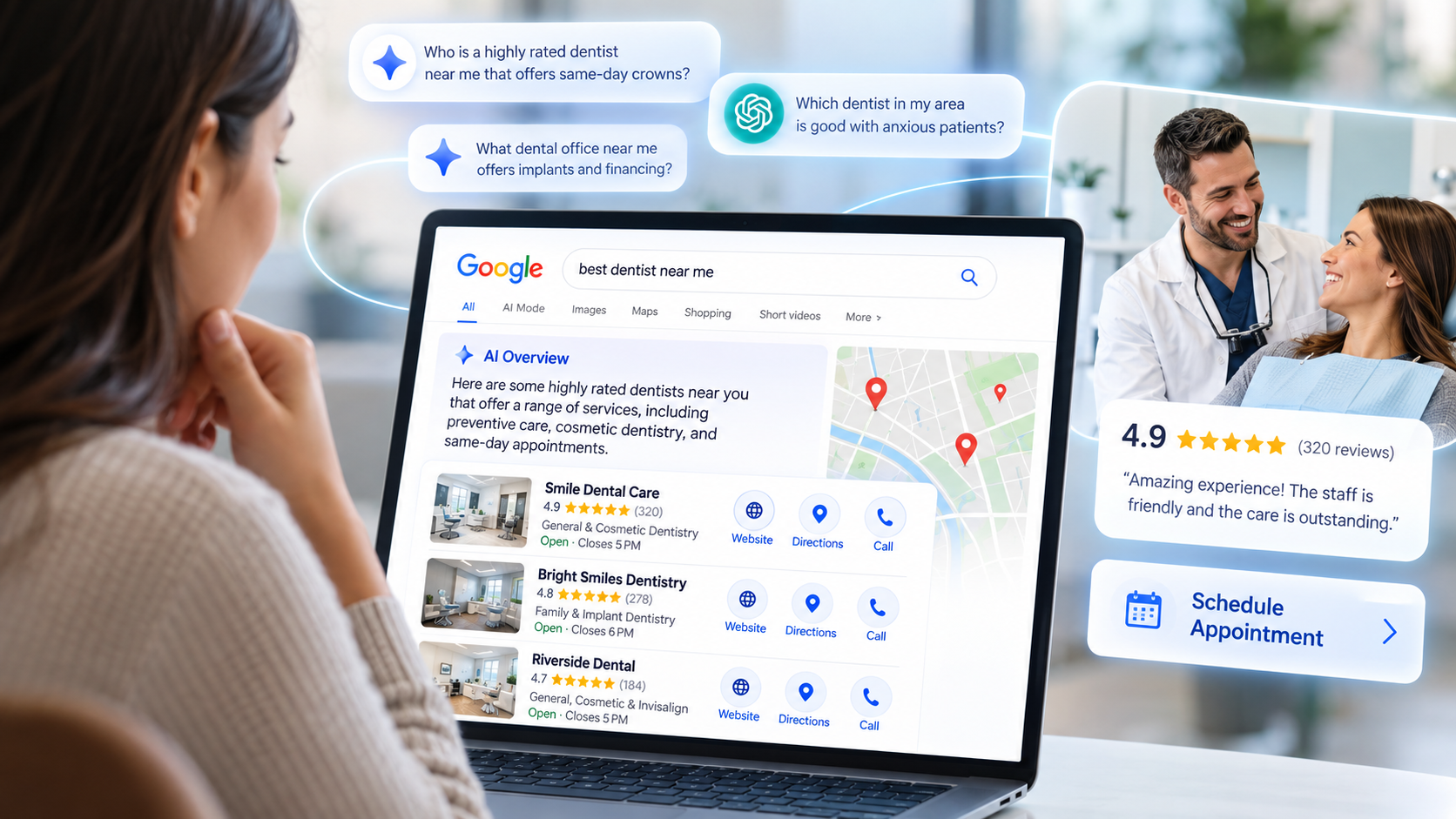
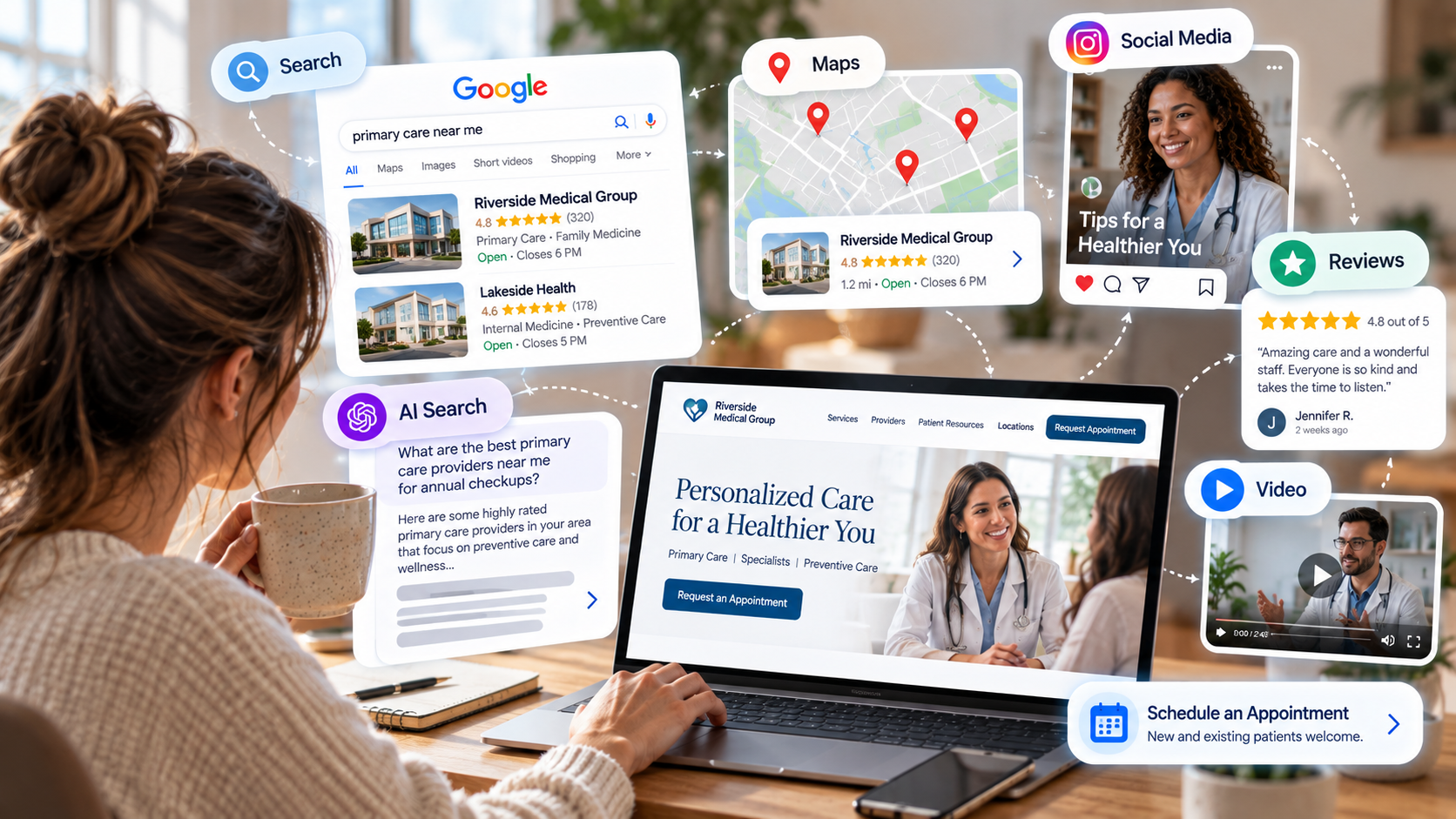
For years, healthcare practices have been told that getting found online starts with one primary goal, ranking on Google.
That is still important, but the way patients discover and evaluate healthcare providers has expanded.
A prospective patient might find your practice through Google Search, see your location in Google Maps, read patient reviews, watch a video from one of your providers, encounter your social media content, or discover your practice while researching a health-related question through an AI-powered search experience.
The path from search to scheduled appointment is no longer limited to one search engine results page.
That is why medical practices should begin thinking beyond traditional search engine optimization and toward a Search Everywhere strategy, an approach designed to make your practice visible, recognizable, and trustworthy across the places patients use to research their healthcare options.
Traditional SEO Is Still the Foundation
Search Everywhere does not mean abandoning SEO.
A strong search engine optimization strategy remains one of the most important foundations of online visibility.
When someone searches for terms such as “doctor near me,” “dermatologist accepting new patients,” “physical therapy near me,” “dentist near me,” or “urgent care open now,” your website needs to give search engines clear information about who you are, where you are located, and what services you provide.
Google explains that its search systems use numerous factors and signals to determine which content is most relevant and useful to a search.
Your website should therefore include comprehensive service pages, accurate location information, useful educational content, strong technical performance, and a clear structure that helps both patients and search engines understand your practice.
But your website is only one part of your digital presence.
Patients Search on Google Maps Too
Consider a patient looking for a new provider close to home or work.
Instead of visiting several individual practice websites, the patient may open Google Maps and compare nearby options.
Within minutes, that person can see locations, office hours, reviews, ratings, photos, directions, phone numbers, and other information.
Google states that local search results are primarily based on relevance, distance, and prominence. It also recommends maintaining complete and accurate business information, responding to reviews, and keeping photos and other details current.
That makes your Google Business Profile an important part of your broader search presence.
For organizations with multiple locations, each office should also be clearly represented so patients can quickly identify the location most relevant to them.
Reviews Have Become Their Own Discovery Channel
Reviews are sometimes treated as something a patient checks after finding a healthcare provider.
In reality, they can be part of how that patient discovers and evaluates the practice in the first place.
A patient comparing several providers may look at ratings, the number of reviews, recent patient experiences, and how the practice responds to feedback before ever visiting a website.
Patient Show has previously explored the importance of leveraging patient reviews to grow a practice. Although the article focuses on dental practices, the broader principle applies throughout healthcare, patient experiences can influence trust and help prospective patients feel more confident about contacting a provider.
Reputation management is therefore more than a customer service function. It is part of your overall visibility strategy.
A Search Everywhere approach considers not only whether your practice appears, but also what a prospective patient sees when it does.
Social Media Is Part of the Research Process
Patients increasingly move between search engines, websites, reviews, and social platforms while researching businesses and services.
For healthcare organizations, social media can help prospective patients become familiar with a practice before they schedule.
Content can introduce physicians, clinicians, and team members, explain services, answer common questions, showcase the practice environment, and provide useful educational information.
A patient might encounter one of your videos or posts today and search for your practice by name several weeks later when they are ready to make an appointment.
That visibility has value even when it does not immediately generate a conversion.
Social media also provides an opportunity to humanize the practice. Healthcare decisions are personal, and patients often want to know more than what services are available. They want to understand who will be caring for them and what they can expect from the experience.
Video Can Answer Questions Before a Patient Calls
Video creates another opportunity to reach patients during the research process.
Think about the questions patients ask before scheduling:
“What happens during my first appointment?”
“How long does this procedure take?”
“What should I expect during recovery?”
“Do I need a referral?”
“What symptoms should I discuss with my provider?”
“What does this treatment involve?”
Many of those questions can become website content, FAQs, social posts, short-form videos, and longer educational videos.
One topic can support multiple channels.
For example, a comprehensive service page could be supported by a provider video explaining the treatment, a social post addressing a common misconception, and an FAQ covering what patients can expect at their first appointment.
Instead of treating each marketing channel as an isolated project, the practice develops an interconnected body of useful information around the services patients are actively researching.
AI Is Creating Another Place for Patients to Search
The search landscape is expanding again with the growth of AI-powered search.
Google now incorporates AI-generated responses into its search experience through AI Overviews and AI Mode. Patients can also use conversational AI platforms to research symptoms, procedures, providers, and healthcare services.
Google says that established SEO best practices remain relevant for its AI search features, including creating helpful content, making pages accessible to search engines, and providing a strong page experience.
This means healthcare organizations do not necessarily need an entirely separate strategy for AI.
They need a stronger overall digital foundation.
Accurate provider information, comprehensive service pages, authoritative educational content, clear location information, and a consistent online presence give search systems more context about the practice.
The objective should not be to create content simply for AI. It should be to provide accurate, useful information that serves patients wherever they encounter it.
Your Website Becomes the Center of the Strategy
When patients can discover your organization across multiple platforms, your website does not become less important.
It becomes the central destination that supports everything else.
A prospective patient may arrive after seeing a Google listing, reading reviews, watching a video, encountering an advertisement, finding social content, or receiving an AI-generated answer.
Once on the website, that person should quickly be able to determine:
Do you provide the care or service I need?
Where are you located?
Who are the providers?
Are you accepting new patients?
What should I expect?
How do I request or schedule an appointment?
Every unnecessary obstacle creates another opportunity for the patient to leave.
That is why visibility and conversion should be considered together. Getting discovered is only the beginning. Your website and patient communication systems need to help turn interest into action.
Consistency Builds Trust Across Channels
A Search Everywhere strategy also requires consistency.
Imagine finding a medical practice on Google that says it closes at 6 p.m., while its website says 5 p.m. A social profile lists an old address, and an online directory includes a provider who is no longer with the organization.
Those discrepancies create confusion and can weaken trust.
Practice names, addresses, phone numbers, hours, providers, services, branding, and core messaging should remain as consistent as possible across your digital presence.
For multi-location or multi-provider organizations, this becomes especially important. Each office and provider needs accurate information while remaining part of a recognizable overall brand.
Paid Advertising Can Strengthen Search Everywhere Visibility
Organic visibility is only part of the picture.
Paid advertising can put a healthcare organization in front of prospective patients who are actively researching services and providers.
The key is not to view advertising as an isolated lead source.
Someone who sees an advertisement may search for the organization by name, check reviews, look up a physician, browse the website, compare other providers, and return later to schedule an appointment.
Each of those interactions contributes to the patient’s overall impression.
This is why Patient Show approaches marketing initiatives as connected parts of a broader patient acquisition strategy rather than isolated tactics.
Measure the Entire Patient Journey
As patient discovery becomes more fragmented, measurement becomes increasingly important.
Website traffic alone does not tell the full story.
Healthcare organizations should also consider calls, appointment requests, online forms, local search activity, advertising performance, lead quality, scheduled patients, and other meaningful conversion data.
The question is not simply, “Did our website get more visitors?”
A more valuable question is, “Which marketing efforts are helping the right patients discover our organization and ultimately take action?”
That distinction can help healthcare organizations make more informed decisions about where to invest their marketing resources.
Be Present Wherever Patients Are Looking
Traditional SEO is not disappearing.
It is becoming one part of a much larger search ecosystem.
Patients can encounter healthcare organizations through search engines, Maps, reviews, social media, videos, advertising, AI-generated results, and recommendations. They may move between several of these touchpoints before deciding to contact a practice.
The goal of a Search Everywhere strategy is not to chase every new platform.
It is to establish a strong, consistent presence across the channels that matter to your patients and make sure those channels work together.
Your website should provide useful information. Your local listings should be accurate. Your reviews should reinforce trust. Your content should answer real patient questions. Your advertising should reach the right audience. Your brand should remain recognizable wherever someone encounters it.
When those pieces work together, your organization has more opportunities to be discovered, remembered, and ultimately chosen.
Patient Show helps healthcare practices develop integrated marketing strategies designed to connect visibility with measurable patient growth. By bringing together websites, search visibility, content, advertising, reputation, and patient acquisition strategies, practices can create a stronger presence throughout the modern patient journey.
Ready to strengthen your practice’s presence wherever prospective patients are searching?
Reach out to us today: marketing@patientshow.com.